Breakthrough Science
In 2017, researchers in Simon Humphrey’s group at The University of Texas at Austin, led in the lab by Sam Dunning, introduced PCM-22, a fluorescent lanthanide metal-organic framework. PCM-22 senses water in organic solvents and can distinguish H₂O from D₂O. Its signal appears as a clear color change,
which enables accurate quantitative sensing as compared to sensors that only change in intensity. This discovery catalyzed the founding of Lantha, Inc., to commercialize a robust, solid-state platform for simple, single-use chemical sensors that reduce reliance on time-consuming lab methods.
Lantha Language
What is PCM-22?
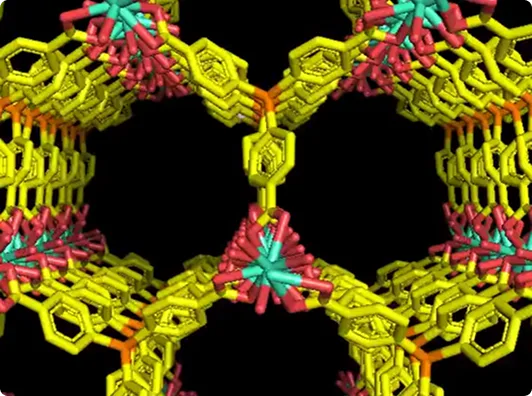
PCM-22 (Phosphine Coordination Material 22) is a metal-organic framework made by linking lanthanide ions to a phosphorus containing organic molecule, creating a crystalline, porous solid that is fluorescent. Mixed-lanthanide versions (for example Eu and Tb) show clear color changes in their fluorescence when small amounts of water are present, which enables quantitative trace-water analysis and practical checks of chemical purity in heavy water and in common organic solvents.

What is a MOF?
A metal-organic framework (MOF) is a crystalline material built by linking metal ions with organic molecules called linkers, forming an extremely porous, 3D network with a huge internal surface area.
Metal–organic frameworks (MOFs) have become a major focus in materials chemistry, explored in thousands of variations for gas storage, separations, catalysis, and water harvesting. The 2025 Nobel Prize in Chemistry to Susumu Kitagawa, Richard Robson, and Omar M. Yaghi acknowledged the field’s scientific importance and practical potential.
What are Lanthanides?
Lanthanides, sometimes called “rare earth elements,” are the 15 elements from lanthanum (La) to lutetium (Lu). They are reactive, silvery metals that usually form +3 ions and occur together in minerals. Some of the lanthanides are fluorescent, however, on their own, they emit very weakly because 4f to 4f transitions are “forbidden.” In materials like PCM-22, the organic linker acts as an antenna: it absorbs UV light and transfers the energy to certain lanthanides such as Tb³⁺ and Eu³⁺, making their green and red emissions bright.
Sensing with PCM-22
PCM-22 is a porous, fluorescent crystal. Molecules from the surrounding liquid enter its pores and interact with lanthanide emitters inside. When exposed to UV light, the framework’s linker absorbs the excitation and transfers energy to the lanthanides, which then emit visible light.
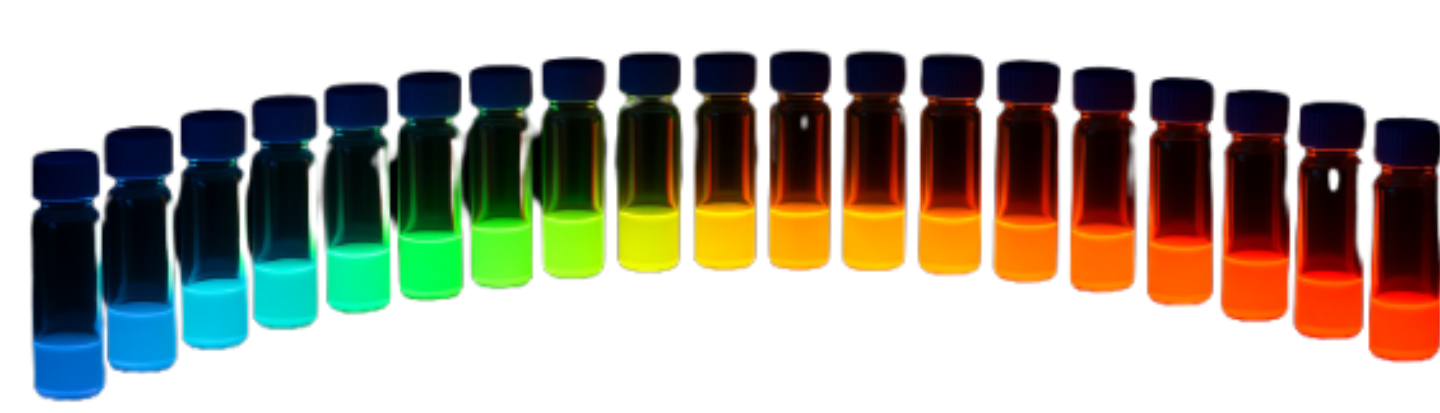
In mixed-lanthanide form, PCM-22 shows ratiometric emission that shifts from red to green as water concentration increases. This built-in color change provides an internal reference: the green-to-red ratio remains consistent even when overall brightness varies. As a result, PCM-22 reports changes in water content rather than fluctuations from excitation power, alignment, or sensor concentration that can distort intensity-based measurements.
FAQs
Technical Performance
Workflow Considerations
Maintenance & Support
News
Nobel Prize
Susumu Kitagawa, Richard Robson and Omar M. Yaghi are awarded the Nobel Prize in Chemistry 2025 for the development of a new type of molecular architecture. The constructions they created – metal–organic frameworks – contain large cavities in which molecules can flow in and out. Researchers have used them to harvest water from desert air, extract pollutants from water, capture carbon dioxide and store hydrogen.
Read more
Get it now
Ready to See Lantha in Action?
Let us know that you are ready to experience effortless testing.
Innovation to Implementation
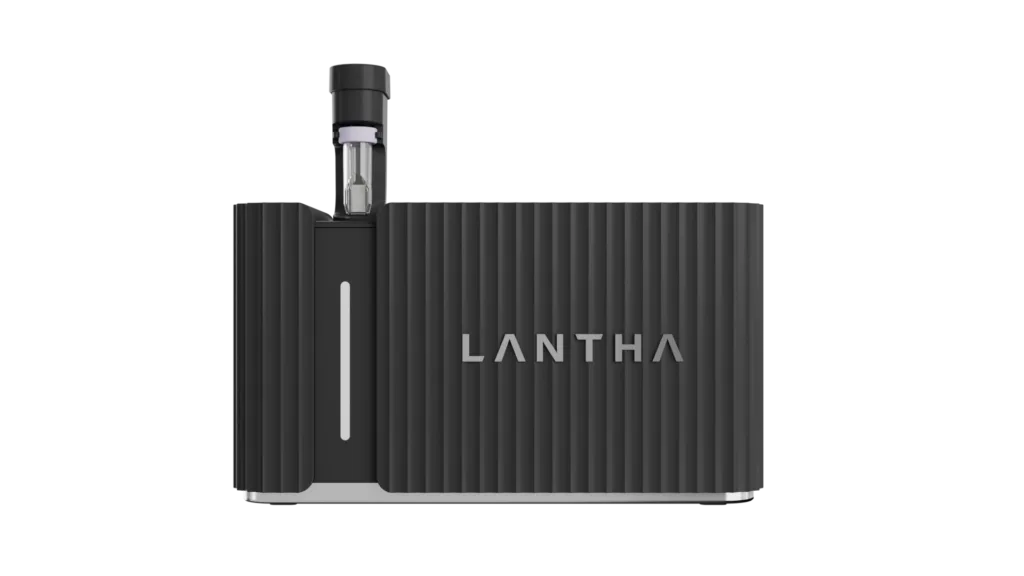
Lantha’s platform unites application-specific sensors, a purpose-built fluorimeter, and intuitive software into a cohesive system that turns fluorescence into clear, quantitative answers.